Current version 22.0.0

Search engine optimisation

Search engine optimisation (SEO) is the process of structuring pages to allow search engines to identify the content of a page.

By making pages search friendly, search engines such as Google are able to surface relevant content in search results to customers. Almost 30% of all traffic on Trade Me comes from organic (non-paid) search results from search engines.

Optimising pages
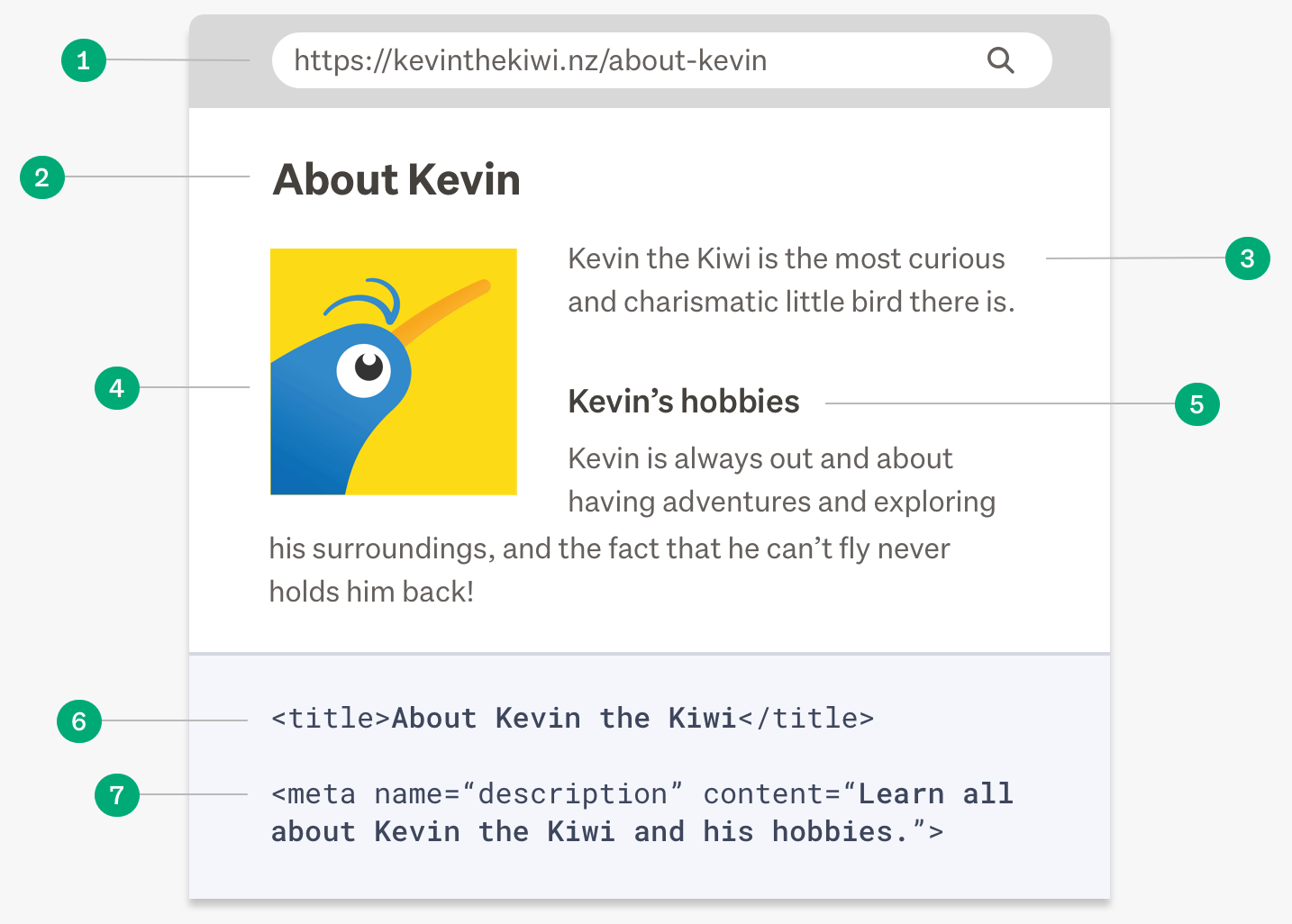
Mock webpage showing seo best practice page structure
  • 1 Secure, clearly named URL that, where possible, matches the, <h1>.
  • 2 Use a single <h1> tag per page.
  • 3 Relevant page content.
  • 4 Image with alt tag description, and descriptive file name.
  • 5 Correct use of heading hierarchy.
  • 6 Include a unique page title no longer than 60 characters. This will appear in the browser tab.
  • 7 Relevant meta description that includes page keywords. This content is surfaced in search results, and lets the customer know what the page is about. This must be no longer than 160 characters.
SEO best practice
DoDon't
Page Structure
  • Use a single <h1> tag on each page, with multiple <h2> and <h3> tags.
  • Don’t use heading tags as navigational elements, as this confuses description content and menu content.
Canonical tags
  • Use a rel=canonical tag on all URLs. This tells Google that this is the authoritative version of a page.
  • Make sure to reference secure URLs (using https://) and use the absolute URL.
  • Don’t forget to apply to Trade Me landing pages.
Internal linking
  • Only use anchor text in links.
  • Link to canonical URLs.
  • Use a rather than button or form for important links.
  • Do not include images or other code in links.
  • Don’t link to duplicate URLs, parameterized URLs or to URLs that redirect.
  • Multiple links to the same URL should not be placed within the DOM.
  • Do not use <button> to link to external URLs.
Hosting
  • Host new pages and projects on trademe.nz.
  • Avoid hosting on subdomains or microsites where possible.
Redirects
  • Implement status code 301 redirects.
  • Don’t use status code 302 redirects, JavaScript or meta refresh redirects.
  • Do not implement chains of redirects, redirect only to the final destination URLs.
Code formatting
  • Remove unnecessary whitespace from your code.
  • Remove unnecessary commented out code from the markup.
  • Minify CSS and JS files to reduce file size.
  • Don’t store non critical CSS or JavaScript inline, instead, store in external files.

Structured data

Use Schema.org markup for on-page elements using JSON LD formatting. Adding tags from this semantic vocabulary improve the way search engines read and represent your page in search results.

Assistive technology also uses this markup.

Understand how structured data works, and read Google’s guidelines on structured data.

Proudly made by © 2026 Trade Me Limited